
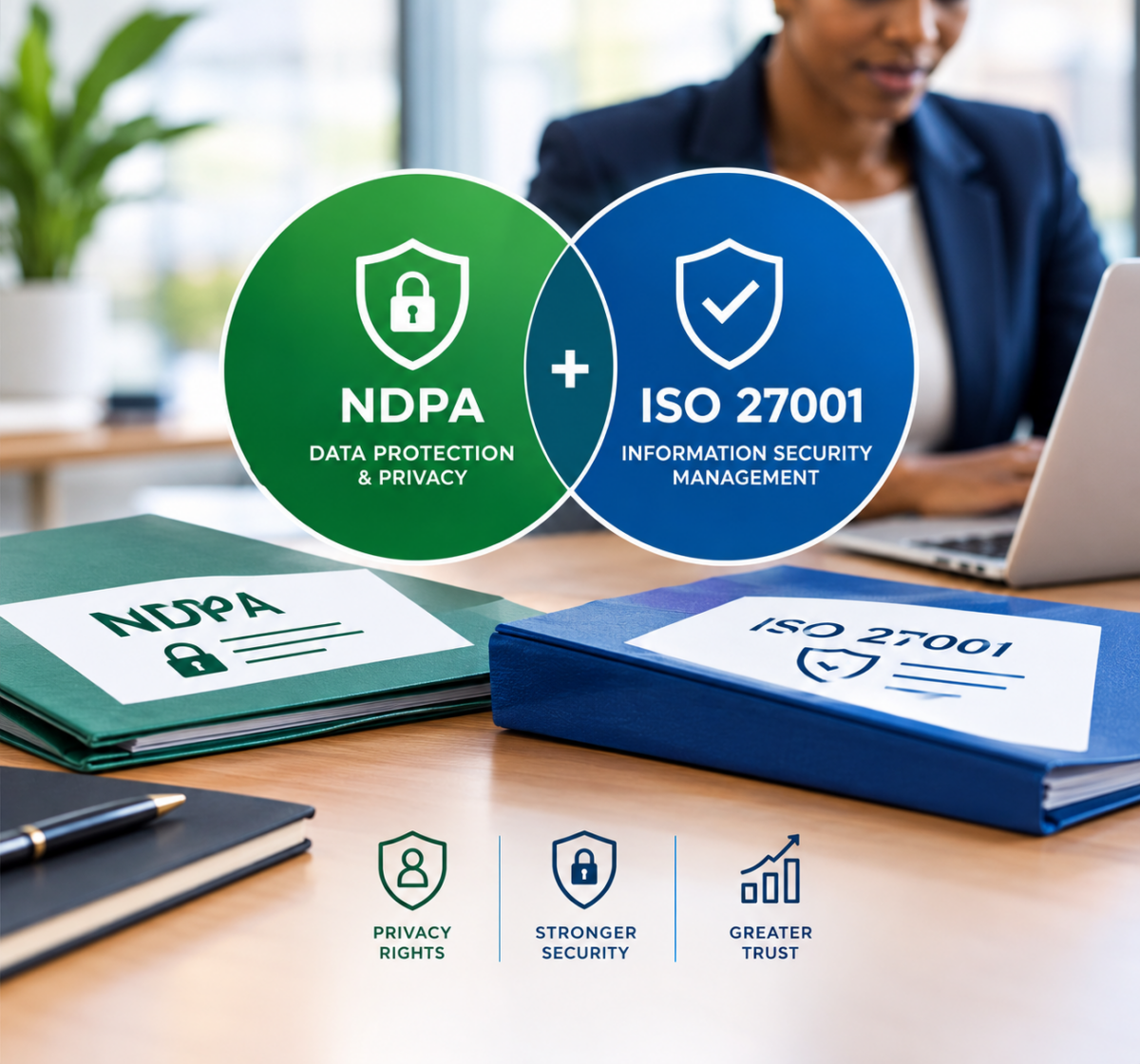
Businesses increasingly face two important challenges: protecting personal information and securing the systems that store and process it. In Nigeria, organisations must understand their obligations under the Nigeria Data Protection Act (NDPA) 2023 while considering internationally recognised information security standards such as ISO 27001. Although these frameworks are related, they serve different purposes. Understanding the difference between NDPA compliance and ISO 27001 can help your organisation reduce risk, strengthen security, and build customer confidence.
What Is NDPA Compliance?
The Nigeria Data Protection Act 2023 establishes the legal framework for protecting personal data in Nigeria. The Nigeria Data Protection Commission (NDPC) oversees the implementation of the Act and supervises compliance with applicable data protection requirements. (National Data Protection Commission)
NDPA compliance means ensuring that your organisation processes personal data lawfully, fairly, transparently, and securely.
Personal data includes information that identifies, or can identify, an individual, such as names, telephone numbers, email addresses, financial details, and employee records.
Depending on the circumstances, organisations must address requirements relating to:
- Lawful processing and transparency.
- Consent and other lawful bases for processing personal data.
- Data subject rights, including applicable rights of access and correction.
- Appropriate technical and organisational security measures.
- Data breach management and applicable notification obligations.
- Data retention and secure disposal.
- Accountability and applicable regulatory registration requirements.
The NDPA applies to organisations and processing activities within its scope. Its requirements are not limited to technology companies; businesses across different sectors may have obligations under the Act.
Importantly, NDPA compliance is a legal obligation, not a voluntary certification. Organisations must meet the requirements applicable to their activities, regardless of whether they hold an ISO certification.
What Is ISO 27001?
ISO/IEC 27001 is an international standard for establishing, implementing, maintaining, and continually improving an Information Security Management System (ISMS).
An ISMS is a structured framework for managing information security risks across an organisation.
Rather than focusing exclusively on personal data, ISO 27001 addresses the protection of information more broadly, including confidential business documents, financial records, intellectual property, operational information, and personal data.
Its approach includes:
- Identifying and assessing information security risks.
- Implementing appropriate security controls.
- Defining information security policies and responsibilities.
- Managing access to systems and sensitive information.
- Preparing for and responding to security incidents.
- Monitoring performance and continually improving security practices.
Organisations can undergo an independent certification audit to demonstrate that their ISMS meets the applicable ISO 27001 requirements.
However, ISO 27001 certification does not automatically guarantee that an organisation is compliant with the NDPA. Certification demonstrates conformity with a defined information security management standard, not complete compliance with every applicable data protection law.
NDPA Compliance vs. ISO 27001: The Key Differences
| Area | NDPA Compliance | ISO 27001 |
| Primary purpose | Protect personal data and individuals’ privacy rights. | Manage information security risks. |
| Nature | Legal and regulatory obligation where applicable. | Voluntary international standard, unless required by a contract or another applicable obligation. |
| Main focus | Lawful processing, transparency, data subject rights, privacy, and accountability. | Confidentiality, integrity, availability, and systematic security risk management. |
| Scope | Personal data processing within the Act’s scope. | Information assets covered by the organisation’s ISMS scope. |
| Assessment | Compliance reviews, audits, regulatory oversight, and other applicable mechanisms. | Internal audits and, where certification is sought, an independent certification audit. |
| Outcome | Compliance with applicable legal requirements. | Certification may demonstrate that an ISMS meets ISO 27001 requirements. |
In practical terms, the NDPA addresses whether personal data is being handled in accordance with applicable legal requirements, while ISO 27001 provides a structured approach to managing information security risks.
Can Your Business Have Both?
Yes. In fact, implementing both frameworks can strengthen your organisation’s overall approach to data protection and information security.
Consider a Nigerian company that processes customer information through an online platform.
To comply with the NDPA, the company must address the lawful processing of personal data, transparency, applicable data subject rights, and other relevant legal obligations.
By implementing ISO 27001, the same company can establish a systematic process for identifying security risks, controlling access, managing vulnerabilities, responding to incidents, and improving its information security practices.
The two frameworks complement each other.
For example, an effective access control system can help protect personal information while supporting the organisation’s wider information security objectives. Similarly, incident management procedures can improve the company’s ability to investigate security incidents and fulfil applicable data breach obligations.
However, implementing one framework does not automatically satisfy every requirement of the other. Organisations should assess both sets of requirements and address any remaining gaps.
How Can Your Organisation Get Started?
Businesses seeking NDPA compliance and ISO 27001 alignment can take the following steps:
1. Assess your current position. Identify the personal data you process, your information assets, existing security controls, and applicable legal obligations.
2. Conduct a gap analysis. Compare your current practices against relevant NDPA requirements and, where applicable, ISO 27001 requirements.
3. Develop appropriate policies and procedures. Establish practical processes for privacy management, information security, access control, incident response, and staff awareness.
4. Implement risk-based controls. Apply safeguards appropriate to the nature of the information, the risks involved, and your organisation’s operations.
5. Monitor and improve. Review compliance and security performance regularly, address identified weaknesses, and update your controls when necessary.
Professional guidance can help organisations coordinate these activities without unnecessarily duplicating documentation or processes.
Strengthen Your Data Protection and Information Security Framework
NDPA compliance and ISO 27001 are not competing alternatives. They address different but complementary aspects of responsible information management.
For Nigerian businesses, combining effective data protection governance with a structured information security management system can help reduce risk, strengthen customer trust, improve operational resilience, and support commercial relationships.
Hastrup Solicitors, a law firm and NDPC-licensed Data Protection Compliance Organisation (DPCO), provides legal and data protection compliance support to organisations seeking to understand their obligations under Nigerian data protection law.
Whether your business needs an NDPA compliance assessment, data protection audit, policy development, or guidance on aligning its privacy practices with ISO 27001, professional support can help you establish a practical path forward.
Contact Hastrup Solicitors at info@hastrupsolicitors.com to discuss your organisation’s data protection and information security requirements.
